
TIF (Total Inorganic Fluorine)
TIF stands for Total Inorganic Fluorine and refers to the total amount of inorganically bound fluorine in a sample. This sum parameter is used to further differentiate the total fluorine content (TF) and to distinguish inorganically bound fluorine from organically bound fluorine (TOF). Individual fluorine compounds or PFAS cannot be determined using TIF.
Table of Contents
- Relationship between TIF, TF, and TOF
- At a glance: TIF
- What role does TIF play in PFAS analysis?
- What can be determined from TF, TIF, and TOF?
- How is TIF determined at Quality Analysis?
- When is it useful to determine Total Inorganic Fluorine?
- The role of TIF in packaging analysis
- Frequently asked questions about TIF
- TIF in summary

Contact us –
expert support is just a conversation away.
Using state-of-the-art analytical methods, we assist you with quality issues, damage claims, and development challenges – providing precise, well-founded, and solution-oriented support.

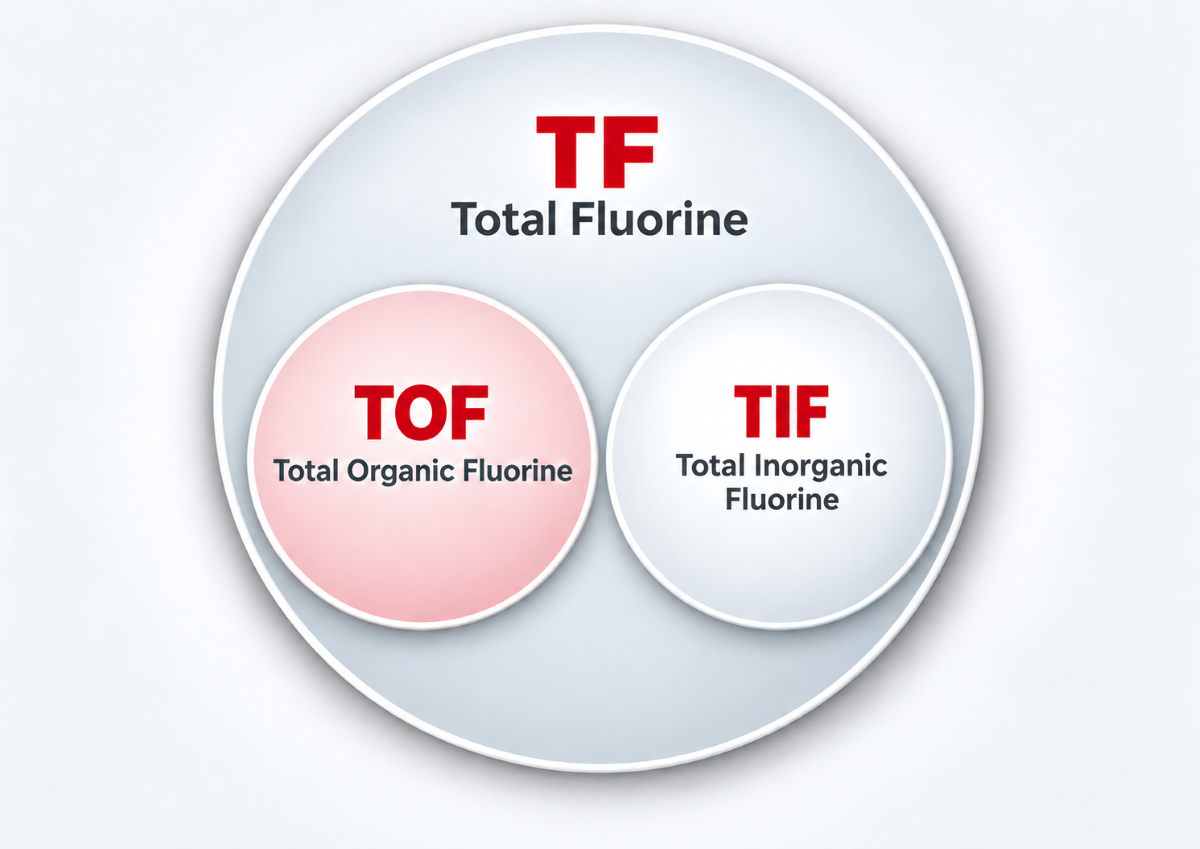
Relationship between TF, TIF, and TOF
TIF is closely related to the sum parameters TF (Total Fluorine) and TOF (Total Organic Fluorine):
- TF represents the total fluorine content of a sample.
- TIF describes the inorganically bound fluorine.
- TOF describes the organically bound fluorine.
In simple terms:

You can find a comparison of the total fluorine parameters here
At a glance
TIF (Total Inorganic Fluorine)
Key characteristics of the TIF summary parameter:
- Inorganic fluorine content: TIF measures the inorganically bound fluorine in a sample.
- Distinction from TOF: Organically bound fluorine is assigned to the total parameter TOF.
- Component of total fluorine: TIF, together with TOF, contributes to the total fluoride content (TF).
- No direct PFAS determination: Individual PFAS compounds cannot be detected using TIF.
- Analytical classification: TIF helps to evaluate measured total fluorine levels in a more differentiated manner.
Zu den anorganischen Fluorverbindungen zählen beispielsweise Fluoride wie Natriumfluorid (NaF). Organische Fluorverbindungen besitzen dagegen eine kohlenstoffhaltige Struktur.
What role does TIF play in PFAS analysis?
An elevated total fluoride content does not automatically mean that there is a correspondingly high PFAS concentration. The measured fluoride may originate partly or entirely from inorganic fluoride compounds. TIF is used to determine the inorganic fluoride content separately. If TOF is calculated from the difference between TF and TIF in an analytical approach, the TIF value is directly incorporated into this calculation. However, neither TIF nor the TOF value derived from it detects individual PFAS compounds.
Analytical classification of fluorine content
TIF is not a method for the direct detection of individual PFAS compounds. Rather, the value serves to determine the inorganic fluorine content and thereby better classify the total fluorine parameters. Especially when used in conjunction with TF and TOF, the results can help provide a more nuanced view of unusual fluorine levels.
What can be inferred from TF, TIF, and TOF?
The three total fluorine parameters address different analytical questions:
| Parameter | What is recorded? |
|---|---|
| TF | Total organic + inorganic fluorine |
| TIF | Total inorganic fluorine |
| TOF | Total organic fluorine |
Considering these parameters together allows for a more nuanced assessment of a sample’s fluoride content.
A high TF value alone initially indicates only that a large total amount of fluoride has been detected. Only further analysis can provide clues as to the proportion that is inorganically or organically bound.
Example: If an elevated TF value is measured and a high TIF fraction is detected at the same time, a corresponding portion of the total fluoride is inorganically bound. The TF value alone would therefore not be sufficient to directly infer the PFAS content.
Determination of TIF
at Quality Analysis
At Quality Analysis, we determine the total inorganic fluorine content using an in-house method. First, the sample is ashed for about 12 hours at approximately 550 °C to remove organic components. The remaining residue is then analyzed using Combustion Ion Chromatography (CIC).
The TIF determination in Quality Analysis thus includes:
- Incineration of the sample at approximately 550 °C for 12 hours
- Removal of organic components
- Analysis of the remaining residue using CIC
- Determination of the inorganic fluorine content
- Interpretation of the result in relation to other total fluorine parameters
When is it appropriate to determine total inorganic fluorine?
A TIF determination is particularly relevant when the total fluorine content of a sample should not be considered in isolation.
This may be appropriate, for example, when:
- an elevated TF value needs to be classified more precisely,
- a distinction needs to be made between organically and inorganically bound fluorine,
- total fluorine parameters are being evaluated in connection with a PFAS analysis,
- materials or products are being examined for their varying fluorine content.
The role of TIF in packaging analysis
In the Packaging Analysis , various total fluorine parameters can be used to assess the total PFAS load. These include the total fluorine content (TF) as well as the sum parameters TOF, AOF , and EOF.
TIF plays a particularly important role in determining TOF (Total Organic Fluorine) : The inorganically bound fluorine content is determined via TIF and taken into account when calculating the organically bound fluorine content.
In simple terms:

Thus, the TIF determination supports the differentiation between inorganically and organically bound fluorine and contributes to the further classification of the total fluorine parameters.
Frequently asked questions about TIF
TIF stands for Total Inorganic Fluorine and refers to the total amount of inorganically bound fluorine in a sample. TIF is a component of total fluorine (TF) and is used to distinguish it from organically bound fluorine.
An elevated TIF value indicates an increased concentration of inorganically bound fluorine in the sample being analyzed. The proportion of this fluorine relative to the total fluorine content can only be assessed by comparing it with the TF value. An elevated TIF value does not allow for the identification of specific inorganic fluorine compounds.
No. PFAS are organic fluorine compounds and therefore are not classified as inorganic fluorine or TIF. Inorganic fluorine can, for example, be present in the form of inorganic fluorides.
No. TIF is not a method for detecting individual PFAS compounds. The parameter measures the inorganically bound fluorine content of a sample and thus helps determine the total fluorine content.
TIF refers to the inorganically bound fluorine content of a sample. TOF stands for Total Organic Fluorine and describes the organically bound fluorine content. Both parameters can be used to more accurately classify the total fluorine (TF).
TOF can be calculated, in simple terms, as the difference between TF and TIF. This assumes that both values were determined using methodologically compatible procedures. Detection limits, measurement uncertainties, and possible losses during sample preparation must be taken into account in the interpretation.
TIF in summary
TIF stands for Total Inorganic Fluorine and refers to the inorganically bound fluorine content of a sample. This parameter helps further differentiate the total fluorine content (TF) and can be used in certain analytical approaches to calculate TOF. TIF does not detect individual inorganic fluorine compounds or PFAS. The interpretability of the result depends on the sample matrix, sample preparation, and the method used.