
What research question would you like to explore?
The choice of analytical methods depends on whether raw materials, internal cell structures, individual components, or recycled fractions are to be evaluated.
| Analytical Task | Appropriate Analysis |
|---|---|
|
Material composition and impurities in raw materials |
|
|
Electrode misalignment, cracks, or abnormalities in the jelly roll |
|
|
Deposits, dendrites, or damage to cellular components |
Glovebox Cell Opening, SEM-EDX, FIB-SEM und Materialography |
|
Recyclable materials, polymers, moisture, and solvents in recycled fractions |
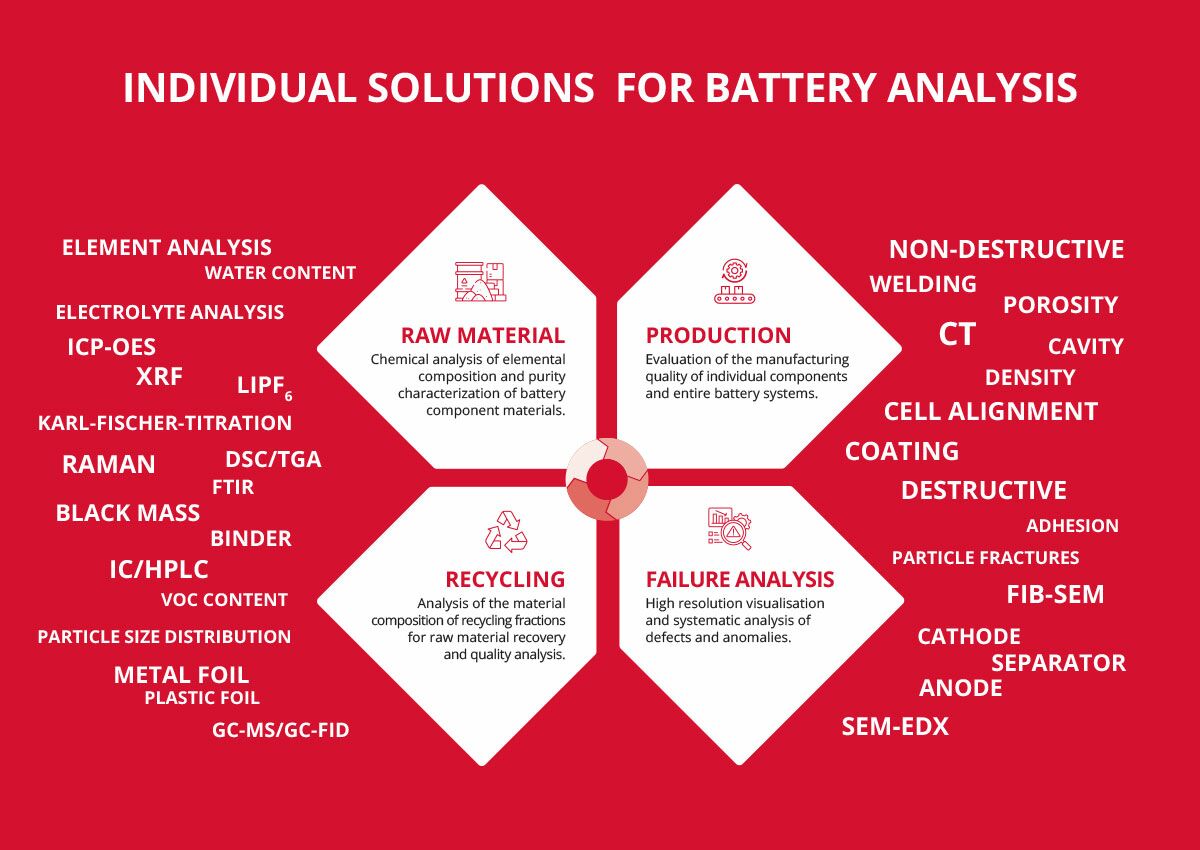
Our battery cell analysis – from raw material testing to recycling
Our individual analysis solutions cover the entire life cycle of battery cells: from the chemical characterisation of the raw materials, through – destructive or non-destructive – production control and in-depth defect analysis, to the precise analysis of recycling fractions such as black mass and metal foils and plastic films – for efficient raw material recovery and sustainable material cycles. In this way, we ensure quality, efficiency and sustainability during all process steps.

Raw material analysis
Detailed analyses of the raw materials for battery components – determination of the material composition and degree of purity as the basis for high-quality, durable products.
- Determination of main and trace elements in raw materials for cathodes, anodes or electrolytes, e. g. lithium, cobalt, nickel, iron, manganese, copper or aluminium (ICP-OES, XRF)
- Analysis of the purity of the cathode and anode material, e. g. for foreign ions that can cause side reactions (RAMAN spectroscopy)
- Particle size distribution, e. g. of cathode material or graphite for the analysis of reactivity and process capability
- Depiction of the surface topography and porosity incl. material identification (laser scanning microscopy, SEM-EDX, computed tomography)
- Determination of the water content in anode and cathode materials to avoid side reactions (Karl Fischer titration)
- Analyses of thermal decomposition, e. g. in binders or electrolyte additives (TGA)

Product control
Analytical evaluation of the quality of individual components as well as the entire battery system – to ensure optimised production processes and high-performance battery cells. Non-destructive and destructive.
- Anode/cathode overhang inspection for pouch and prismatic cells
- Assembly and safety check (2D X-ray inspection, pressure test)
- Homogeneity of the jelly roll, e.g. electrode spacing, curvature or cracks (CT)
- Cell alignment and dimensional accuracy (optical 3D scanning)
- Strength of the bonding of the electrode coating by means of a pull-off test
- Determination of the residual moisture in coated electrodes (Karl Fischer titration)
- Characterisation of the quality of cut edges, electrode offset or edge definition
- Thermal characterisation of separators and electrolytes (DSC, TGA)

Damage analysis (postmortem analysis)
High-resolution depiction and systematic defect analysis for the specific identification of defects and anomalies – as the basis for research into causes, process optimisation and improving quality.
- Analysis for anomalies or cracks in the electrode coating, particle fractures, cavities, inhomogeneous distribution of the active materials, intercrystalline corrosion and much more (materialographic and computed tomography analyses)
- Analysis of weld seams, cracking, electrolyte loss or incorrect wetting (SEM, FIB-SEM, computed tomography)
- Microscopic analysis in a cross-section
- Depth profile of flaws by means of FIB-SEM analysis
- Depiction of the surface topography incl. material identification, e.g. for deposits (SEM-EDX analysis)
- Analysis for dendrites, e.g. after short circuit

Recycling analysis
Precise characterisation of recycling fractions for the recovery of valuable raw materials and quality assurance of secondary materials – for an efficient, sustainable material cycle.
- Fractionation and comminution of the samples (e. g. sieving, grinding) as preparation for elemental analytics, if necessary microwave-assisted acid digestion
- Determination of the recyclable material content of the black mass, e.g. lithium, cobalt, nickel and manganese, copper, aluminium or graphite (ICP-OES, XRF)
- Analysis of the particle size distribution
- Identification and quantitative verification of polymer constituents (TGA, DSC, FTIR)
- Determination of the VOC content (TGA, coupled with FTIR spectroscopy and GC-MS)
- Determination of moisture and residual solvent content (Karl Fischer titration)
- Electrolyte analysis and identification of solvents (IC, GC-MS)
What Results does
Battery Cell Analysis Provide?
Depending on the specific research question, the analyses provide information on material composition, impurities, internal cell structures, and damage to electrodes, separators, and other cell components. The results serve as the basis for raw material assessment, process optimization, root cause analysis, and recycling decisions.
- Elemental and purity analyses of raw materials and recycling fractions
- Characterisation of physical and structural material characteristics
- Analytical evaluation from individual cell components to complex battery systems
- Analysis of residual moisture, solvents and VOCs to ensure material purity and safety
Contact us –
expert support is just a conversation away.
Using state-of-the-art analytical methods, we assist you with quality issues, damage claims, and development challenges – providing precise, well-founded, and solution-oriented support.

Added value at Quality Analysis
Speed
You receive from us precise measurement results, even at short notice. We have both the necessary personnel and a large number of analysis systems for precise analysis of battery cells throughout their entire life cycle.
Variety of analyses
We analyse battery raw materials, battery components and entire battery systems using various methods and techniques from the fields of chemical analytics, materialography, computed tomography and technical cleanliness verification.
Analysis systems
Our technical equipment is suitable for all battery cell analysis requirements. In our specialist areas, we rely on systems from market leaders such as Renishaw, Bruker, Agilent and Metrohm, as well as ZEISS, Baker Hughes, Ametek and many more.
Accreditation
The accreditation of our inspection methods and measuring rooms signifies for your certainty, dependability and objectivity.

ACCREDITED TEST LABORATORY
FOR battery cell analytics
Our DAkkS accreditation in accordance with DIN EN ISO/IEC 17025 stands for certified quality and maximum certainty. You benefit from test methods compliant with standards, validated methods and internationally recognised test results. As a reliable partner, we support you throughout the entire life cycle of the battery cell – from raw material characterisation to the analysis of recycling fractions.
You can read more about the advantages our accreditation offers you here:
Frequently asked questions about
battery cell analytics and recycling
Battery analytics is the systematic analysis of battery cells to evaluate their chemical, physical and electrochemical characteristics. The goal is to detect and understand ageing processes, performance degradation and safety risks at an early stage. Methods such as postmortem analysis as well as structure and material-based methods provide valuable insights for development, quality assurance and recycling. Quality Analysis offers comprehensive battery cell analytics for the automotive industry, for energy storage and research – for maximum safety, efficiency and sustainability in your battery development.
The battery is analysed throughout its entire life cycle – from raw material testing to damage analysis. Chemical, physical and imaging methods permit substantiated statements about purity, material characteristics and production quality. These methods include:
- Raw material analysis (e. g. elemental composition, particle sizes)
- Production control (e. g. 2D-X-ray inspection, 3D scanning, adhesion tests)
- Postmortem analytics if defects occur (e. g. SEM, FIB-SEM, 3D-CT)
Whether for process monitoring, fault diagnostics or the recovery of raw materials – precise analysis of battery cells is the basis for high-performance, durable energy components.
Battery cell analytics is crucial for battery research, because it provides insights into the composition, purity and structure of the raw materials used and their interaction. It permits the precise evaluation of material characteristics and thus the targeted development of more powerful, durable and sustainable batteries.
Battery cell analytics can be used during the entire recycling process. This application starts with the analysis of the black mass, by means of which specific conclusions can be drawn as to market value, and ranges through the control of the purity of the recycling fractions to the determination of the physical-chemical characteristics. Depending on the task, we use different methods, such as scanning electron microscopy, Karl Fischer titration or for non-destructive inspection X-ray fluorescence analysis and many more.
Currently many different methods are used for recycling batteries. The challenge for battery research is, among others, to develop methods that are both economically viable as well as technically efficient and sustainable. Battery cell analytics also make a valuable contribution here, for instance by determining the purity of the recycling fractions obtained using a specific method. In this way direct comparisons between different methods are possible.
Battery cell analysis enables the early detection of material defects, manufacturing deviations, and aging processes. This helps improve battery safety, performance, and lifespan, while reducing development and production costs.
In general, lithium-ion batteries, sodium-ion batteries, solid-state batteries, and other electrochemical energy storage devices can be analyzed. The choice of analytical method depends on the cell chemistry, design, and research question.
The analysis of black mass is used to determine its chemical composition and purity. Using modern analytical methods, valuable raw materials such as lithium, nickel, cobalt, and manganese are quantified, and impurities and material properties are examined. The results provide important information for assessing the material’s value and optimizing recycling processes.
Defects in battery cells are detected using non-destructive and destructive analytical methods. Techniques such as computed tomography (CT) or 2D X-ray analysis reveal internal structural defects, while post-mortem examinations using SEM or FIB-SEM provide detailed insights into material damage and aging mechanisms. This allows the causes of defects to be specifically identified and future failures to be prevented.

Quality Analysis –
the right partner
for battery cell analysis
What can we analyze for you?
We would be pleased to advise you about the numerous possibilities and combined analytical methods. Our goal: the best, most cost-effective and most efficient analysis of your material or component.