
Water analytics in the laboratory – your advantages
The analysis of your sample by our accredited test laboratory offers you many advantages. We provide you with detailed, comprehensive advice about the analysis options. In this way we create a bespoke solution for the requirements of each customer. Our personnel have extensive expertise in this area. As a consequence we are able to undertake the necessary measurements not only quickly and precisely, but also with a high degree of repeatability. In this way different samples can be compared reliably at any time. This situation gives you the certainty that a task as demanding and challenging as water analytics is in the best hands.
Fast, reliable
measurement results
- pH measurement
- Conductivity measurement
- Determination of the water hardness
- Determination of the biochemical oxygen demand (BOD) in accordance with DIN EN 1899-1
- Determination of the chemical oxygen demand (COD) in accordance with DIN ISO 15705
- Determination of the total organic carbon (TOC) in accordance with DIN EN 1484
- Turbidity measurement in accordance with DIN EN ISO 7025
- Color measurement (photometric) in accordance with DIN EN ISO 7887 (color index, Hazen, iodine, Gardner, yellowness)
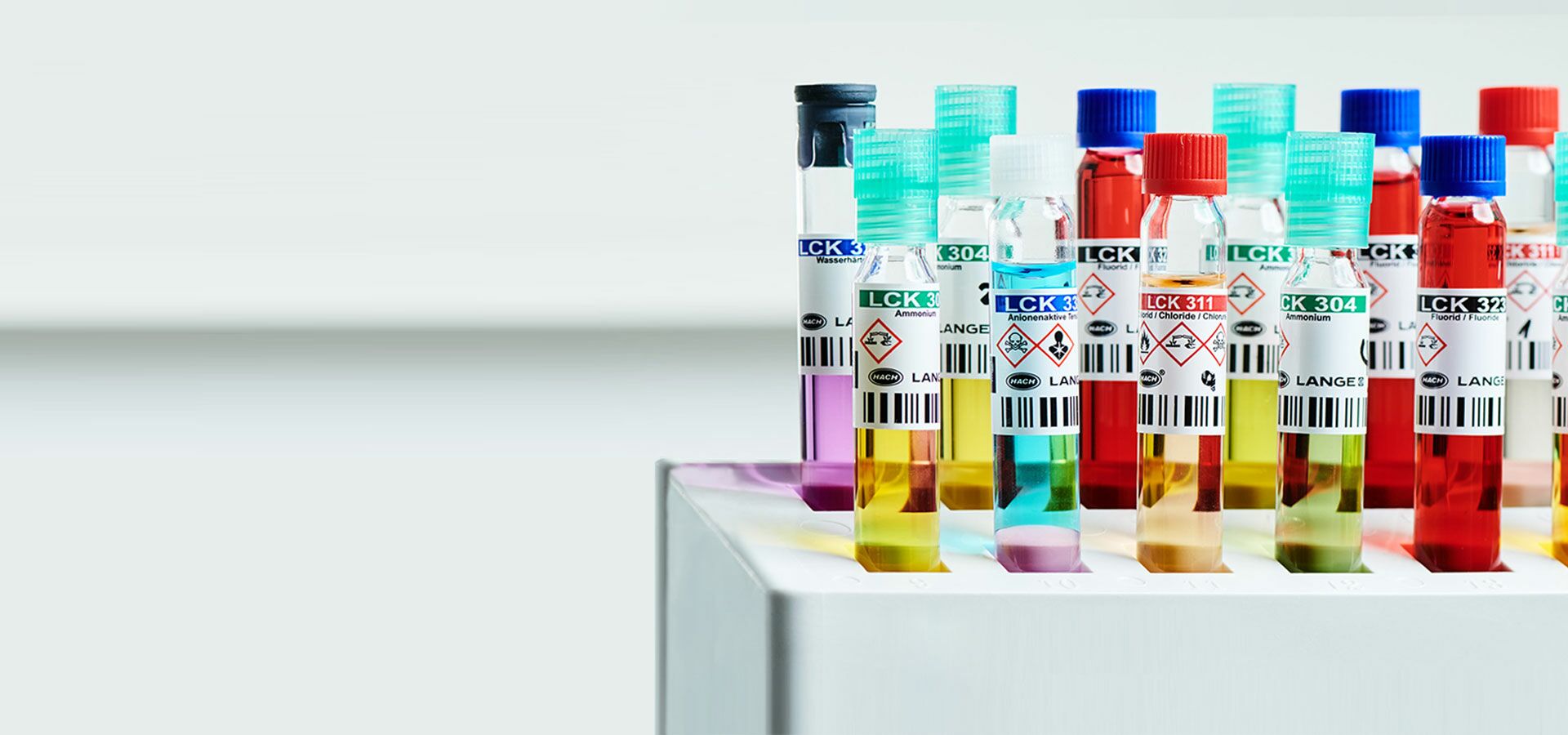
- Quantitative assessment of organic and inorganic substances (e.g. nitrites, nitrates, sulphates, ammonia, iron, manganese, chloride, calcium, magnesium, fluoride, anionic tensides and other substances)
Technical equipment
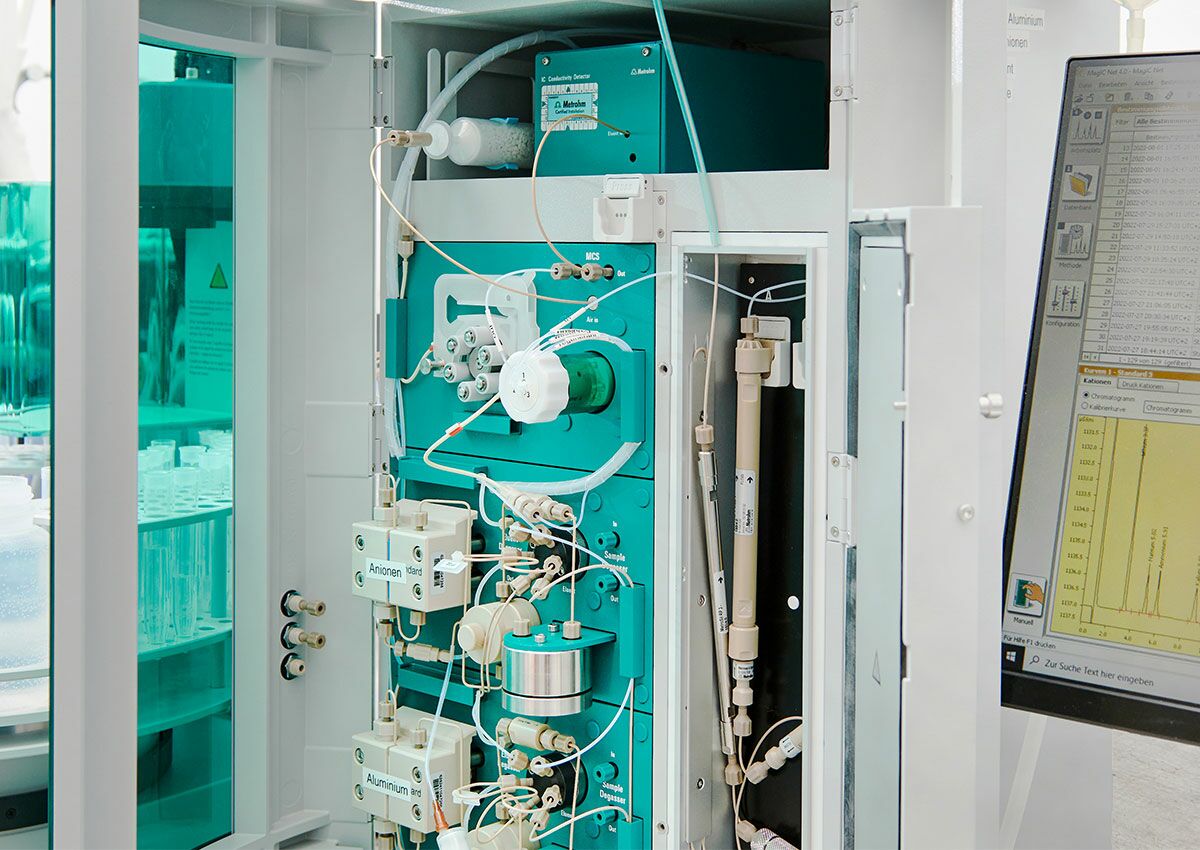
We have a collection of reliable, robust equipment from renowned German brand-name manufacturers for the analysis of your process water sample. Thanks to our versatile equipment, we are able to undertake a large spectrum of physical and chemical analyses. These include anion and cation analytics, conductivity and, of course, also the pH value. For this purpose, we use the following equipment:
- Metrohm 940 Professional IC Vario (HPLC and IC system)
- Hach Lange DR 6000 UV-VIS spectral photometer
- Hach TL2310 ISO turbidimeter
- Hach HQ40D multi-parameter meter incl. pH electrode and conductivity electrode
Added value at quality analysis
Speed
You receive from us precise measurement results, even at short notice. We have the necessary analysis systems and the necessary personnel for a quick industrial water analysis.
Quality
We provide analyses for process water, cleaning baths and water-mixed cooling lubricants. For this purpose, we have approx. 500 m² of accredited, permanently air-conditioned laboratory rooms.
Range of equipment
Our technical facilities are equipped to suit your needs. We have the right measuring instrument for every measuring task. We rely on Metrohm and Hach for our systems.
Accreditation
The accreditation of our inspection methods and measuring rooms signifies for you certainty, dependability and objectivity.

Challenges of water analytics
Water analyses appear straightforward to undertake with automated equipment, however in practice it is necessary to pay attention to many different factors because comparable results from different samples can only be obtained if the different measurements are always based on the same parameters. This aspect starts already with the sampling and ends with the correct cleaning and storage of the measuring cuvettes. The large range of methods available also requires comprehensive knowledge of their application.
Accredited test laboratory
for chemical analytics
Chemical and physico-chemical analytics of plastics and elastomers to determine thermal properties and composition, elemental analysis, identification and quantification of organic and inorganic substances, materials, residues, deposits and contaminants using FT-lR and energy dispersive (EDX) spectroscopy are accredited by Deutsche Akkreditierungsstelle GmbH (DAkkS) in accordance with DIN EN ISO/IEC 17025. Furthermore, all our other specialist areas have also been accredited.
Read more about the advantages our accreditation offers you here:
Frequently asked questions about water analytics
Water analytics refers to the analysis of water samples in relation to their physical, chemical and microbiological properties. Familiar examples are the analysis of drinking water for quality control in the context of drinking water regulations, or the analysis of bodies of water such as rivers for chemical residues that enter the water, for example, due to agriculture or insufficiently treated sewage. A less well-known, but none the less important branch of water analytics is the analysis of process water, cleaning baths and cooling lubricants in industry.
The methods for analysing the samples are as varied as the tasks that arise during water analytics. At this point we can therefore only provide a little insight into the methods we use during the analysis of process water, water-mixed cooling lubricants and cleaning baths. Our central analysis services are turbidity measurement and colour measurement. However the quantitative assessment of organic and inorganic constituents is also possible. We do not undertake biological analyses, for example the familiar analysis of drinking water for legionella.
Again for water analytics: the instruments used are as varied as the tasks. Among others, we use a spectral photometer for our services. This instrument determines the diffuse reflectance of the sample by measuring the light intensity in relation to the wavelength. In this way it can be determined how much light is absorbed by a sample. Our turbidimeter, on the other hand, operates on a different principle. It measures the reflection of light by particles in the sample. With various probes we are also able to determine the pH value, the conductivity, the oxygen demand and other parameters.
Our Hach TL2310 turbidimeter uses an LED light source that operates with light with a wavelength of 860 nm (±30 nm). This is a nephelometric instrument, this means that the turbidity is not measured based on the rate of absorption of the light, but instead based on the reflection of the light by the clouding particles. The degree of reflection here is, of course, not only dependent on the quantity of particles in the sample, but also on their properties such as shape, reflectivity, etc. Measurements are possible in the range from 0 to 1,000 FTU or NTU.
The pH value (from potentia Hydrogenii, potential of hydrogen) is a measure for the acidity or basicity of a solution. It is the negative decimal logarithm of the hydrogen ion activity - or expressed more simply: the lower the pH value, the higher the concentration of hydrogen ions. The pH value is an indicator for the evaluation of the quality of water. If the pH value is too low, that is the water is too acidic, metal ions may become detached from pipes and other parts causing contamination of the process water or similar effects. In principle, the pH value of all chemicals can be determined, as long as they are liquid.

Quality Analysis
the right partner
for water analytics
What can we measure and analyse for you?
We would be pleased to advise you about the numerous possibilities and combined analytical methods. The goal: the best, most cost-effective and most efficient analysis of your component.