
FAST, RELIABLE
MEASUREMENT RESULTS
- Assessment of thermal characteristics such as melting temperature, glass transition temperature and crystallinity
- Determination of material composition, e.g. proportions of polymers, plasticisers, filler materials or the residual mass
- Analysis of thermal decomposition behavior
- For the identification and quantification of decomposition products and volatile components, we offer the coupling of TGA with FTIR and GC-MS
DIFFERENTIAL SCANNING CALORIMETRY (DSC)

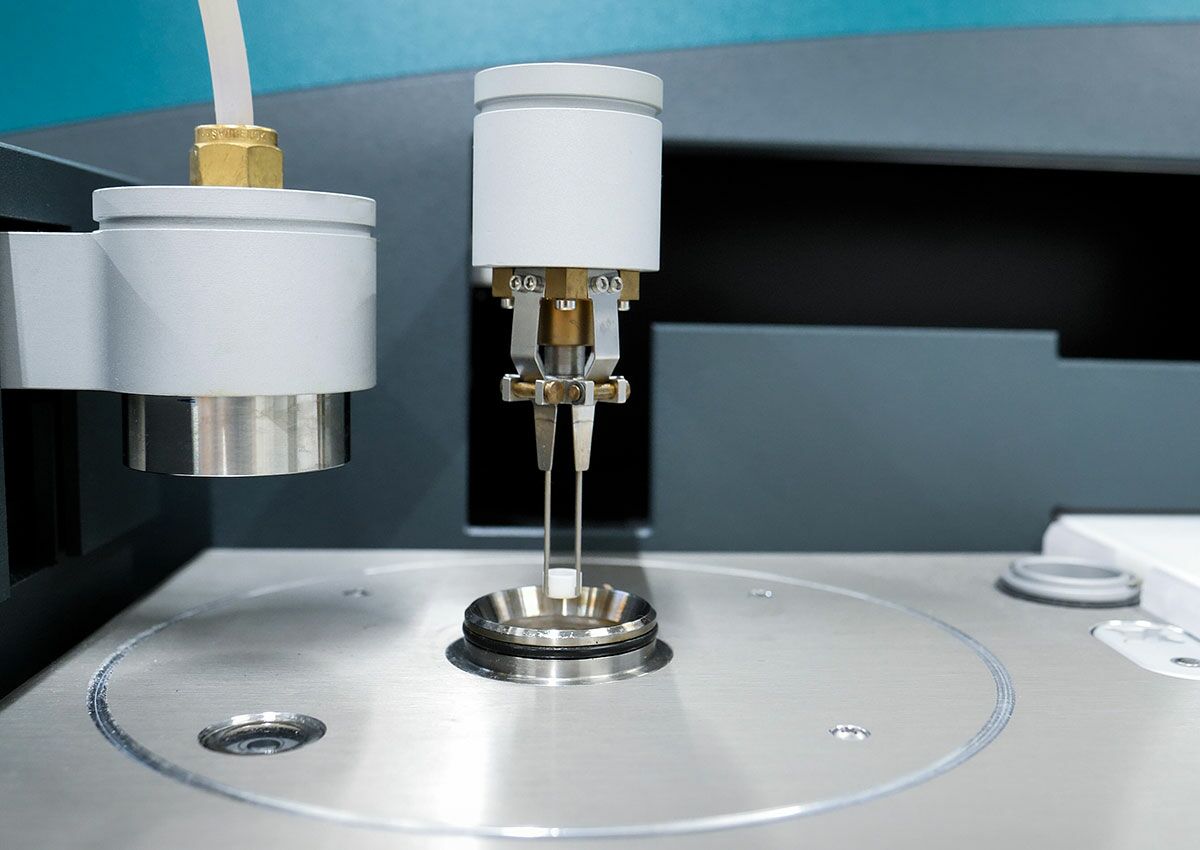
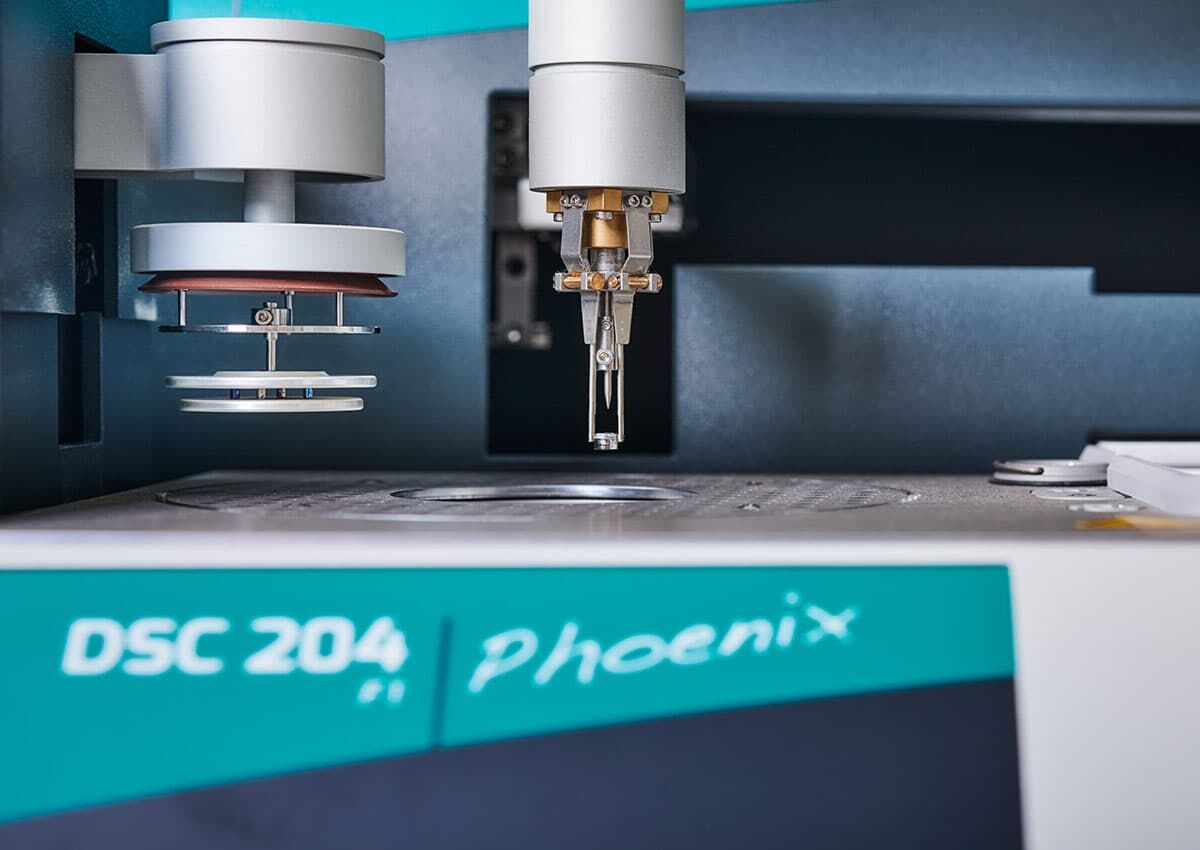
Differential scanning calorimetry (DSC) permits the determination of parameters for characterising the thermal properties of your material. We use DSC to analyse a variety of sample types, including solids such as polymers or metals, liquid samples, powders, fibres or viscous samples, e.g. creams.
DSC parameters
- Melting temperature
- Glass transition temperature
- Enthalpy changes (melting and crystallisation points)
- Crosslinking temperatures/enthalpies
- Crystallinity
- Specific heat capacity
- Oxidation stability
Information from
DSC parameters
- Material identity and formulation components
- Modifications and additional components
- Material composition
- Purity/contamination
- Thermal history
- Tempering effects
- Crystallinity/degree of crystallinity
- Curing state/degree of curing
- Phase transitions
Applications
- Quality control
- Incoming goods inspection
- Process optimisation
- Damage analytics
- Analysis of competitor products
- Thermo-mechanical history
Application example DSC
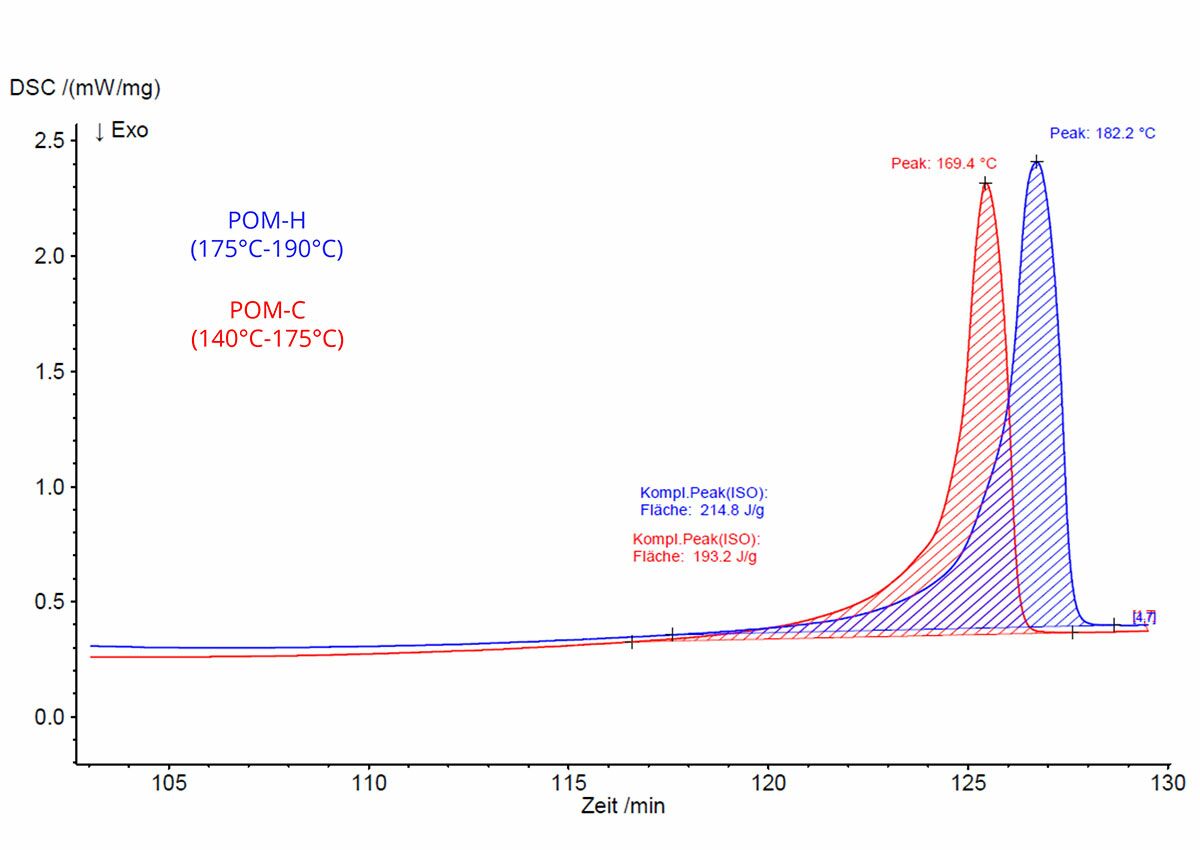
A failure can have many different causes, such as incorrect material selection, manufacturing errors in the plastic raw material or production defects. DSC is used in incoming goods inspection to assure the quality of incoming materials – especially plastics, polymers, adhesives or active pharmaceutical ingredients. By comparing the melting temperature of the batch with a reference, it can be ensured that the material supplied corresponds to the specified raw material.
During the material-characterising second heating of two material samples, the sample material (red) exhibits a lower melting peak than the reference material (blue). A comparison with values in the literature clearly shows that the material supplied is POM-C instead of POM-H. POM-H features superior overall mechanical characteristics, particularly in terms of hardness, rigidity, tensile and compressive strength. The use of POM-C could result in mechanical changes to the product.
THERMOGRAVIMETRIC ANALYSIS (TGA)

Thermogravimetric analysis (TGA) provides – in addition to DSC – further characteristic information. Using TGA we measure how the mass of a sample changes as a function of temperature or time. This information is used for the development of various solid or liquid materials and substances; it also provides insights into thermal stability and composition. For extended material characterisation, especially in the field of plastics analytics, we offer coupling with gas chromatography-mass spectrometry (GC-MS) and Fourier transform infrared spectroscopy (FTIR).
TGA parameters
- Mass changes
- Filler material content (glass fibres, carbon black, chalk, other inorganic filler materials)
- Material/polymer content
- Plasticiser content and other additives
- Residual mass/ash
- Decomposition temperature/behaviour
Coupling with FTIR and GC-MS
Identification of decomposition products:
- Polymers
- Solvents
- Plasticisers
- Additives
- Propellants
Applications
- Quality control
- Incoming goods inspection
- Process optimisation
- Damage analytics
- Analysis of competitor products
Application example TGA
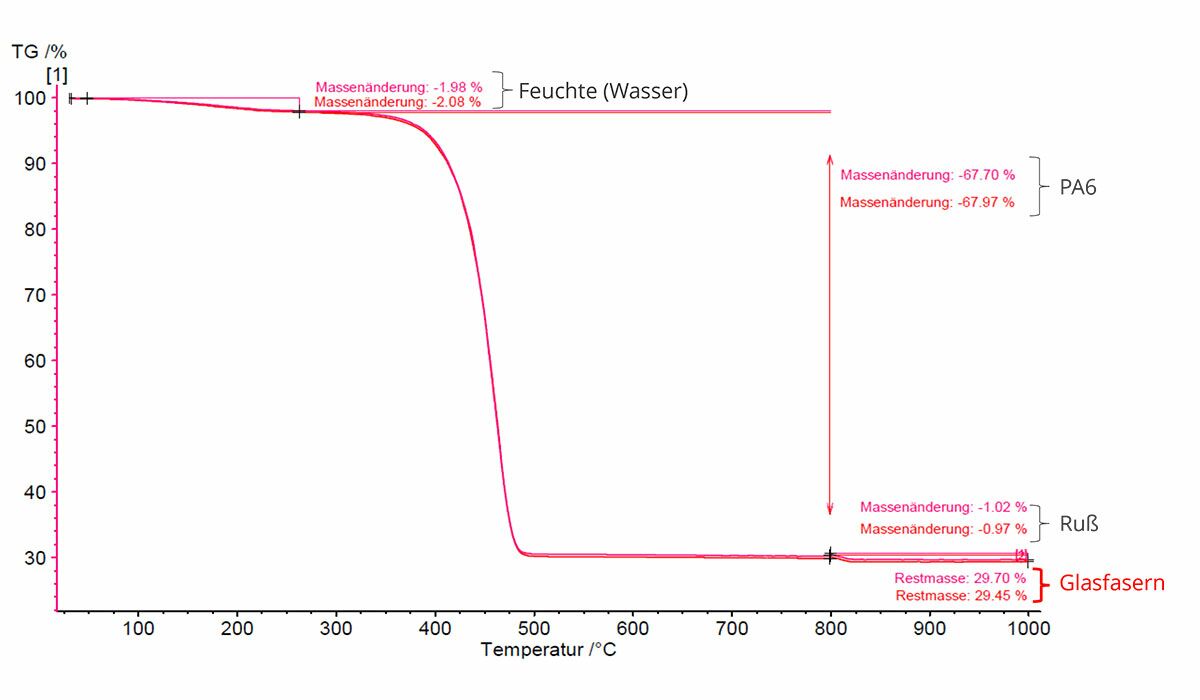
Whereas filler materials and additives used to be employed primarily to reduce production costs, today they are primarily used to optimise the technical characteristics of polymer materials. TGA is an important method for checking the material composition as part of quality assurance, incoming goods inspection and damage analysis. It provides important insights into the stability, composition and purity of materials.
The determination of the glass fibre content or the purity of polymers plays a particularly important role in the plastics industry. In this example, the inorganic filler materials (e.g. glass fibre in this case) in a glass fibre-filled PA 6 sample are determined using TG. After heating the sample to 1000 °C, the glass fibres remain in the crucible as a residual mass. The glass fibre content of the samples is 30 % and thus corresponds to the material specification of PA6 GF30.
ALL ANALYSES FROM A SINGLE PROVIDER
At Quality Analysis you profit from a comprehensive spectrum of chemical analytics. We analyse organic and inorganic substances using various modern analytical methods and systems in the areas of microscopy, spectroscopy, chromatography, thermal analyses and wet-chemical analytics. Thanks to this comprehensive selection of methods and networking, we can offer you substantiated answers to almost all analytical questions – quickly, efficiently and from a single provider.
Added Value at Quality Analysis
Speed
You receive from us precise measurement results, even at short notice. We have both the necessary personnel and a large number of analysis systems for chemical analytics.
Variety of analyses
We analyse organic and inorganic substances using various analytical methods in the areas of microscopy, spectroscopy, chromatography, as well as thermal and wet-chemical analytics.
Analysis systems
Our high-quality technical equipment is optimised to meet your requirements. The right system is available for every analysis task – with state-of-the-art technology from leading manufacturers such as Netzsch, Renishaw, Bruker, Agilent, Metrohm, Hach and many more.
Accreditation
The accreditation of our inspection methods and measuring rooms signifies for you certainty, dependability and objectivity.
Technical Terms - Explained in an interesting ways
Frequently asked questions about Thermal Analyses
Thermal analysis examines how materials behave when exposed to changes in temperature. Depending on the analytical method, properties such as melting temperature, glass transition temperature, crystallinity, thermal stability, decomposition behavior, filler content, additives, and residual mass can be determined.
Thermal analysis is useful for material characterization, formulation verification, raw material comparison, and failure analysis. Typical applications include quality assurance, incoming goods inspection, process optimization, failure investigations, and competitive product analysis.
Differential Scanning Calorimetry (DSC) measures the amount of heat absorbed or released by a material during temperature changes. It can be used to determine melting temperature, glass transition temperature, crystallinity, enthalpy changes, degree of cure, and the thermal history of a material.
Thermogravimetric Analysis (TGA) measures the change in mass of a sample as a function of temperature or time. It is used to evaluate thermal stability, decomposition behavior, filler content, polymer content, plasticizer content, additives, and residual mass or ash content.
ACCREDITED CHEMICAL LABORATORY
The following tests are accredited by the Deutsche Akkreditierungsstelle GmbH (DAkkS) in accordance with DIN EN ISO/IEC 17025: chemical and physical-chemical tests on plastics and elastomers to determine thermal characteristics and composition, element determination, identification and quantification of organic and inorganic substances, materials, residues, deposits and contamination using FTIR and energy-dispersive (EDX) spectroscopy. We are one of the few test laboratories in Europe in which all specialist areas have been successfully accredited.
You can read more about the advantages our accreditation offers you here:

Quality Analysis
the right partner
for thermal analyses
What can we measure and analyse for you?
We would be pleased to advise you about the numerous possibilities and combined analytical methods. The goal: the best, most cost-effective and most efficient analysis of your component.