
Optical emission spectroscopy with inductively coupled plasma (ICP-OES)
Inductively coupled plasma optical emission spectroscopy (ICP-OES) is an analytical method for determining the elemental composition of liquid samples.
Table of contents

Contact us –
expert support is just a conversation away.
Using state-of-the-art analytical methods, we assist you with quality issues, damage claims, and development challenges – providing precise, well-founded, and solution-oriented support.

How does ICP-OES work?
Optical emission spectroscopy with inductively coupled plasma (ICP-OES) permits the simultaneous analysis of metals and numerous non-metals in liquid samples. This method is based on generating an inductively coupled plasma and the analysis of the light emitted by excited atoms. In this way, elements contained in the sample can be identified and their quantities precisely determined.
1.
Sample preparation and plasma generation
During ICP-OES, the liquid sample is converted into an aerosol by means of an atomiser and injected into an ionised gas (argon), the so-called plasma. The atoms and ions contained in the sample are stimulated to emit element-specific radiation. Each element emits light at a characteristic wavelength, which is specific to the respective element like a "fingerprint".
2.
Axial and radial assessment of the plasma
By assessing the plasma from two different perspectives, both high and low element concentrations in the sample can be reliably verified. Axial assessment of the plasma is characterised by high sensitivity during detection and is particularly suitable for trace analysis. Radial assessment, on the other hand, permits a more precise measurement and is better suited to samples with high matrix content and organic solutions.
3.
Spectral analysis and quantification
The light emitted is acquired by an optical system and passed through a spectrometer. The spectrometer separates the light into its different wavelengths. The intensity of the radiation emitted at each wavelength is measured using a detector. This intensity is directly proportional to the concentration of the related element in the sample. By comparing the intensities measured with calibration standards, the exact quantity of the elements in the sample can be determined.
Precise elemental analysis
at Quality Analysis
Optical emission spectroscopy with inductively coupled plasma (ICP-OES) is a reliable analytical method for the qualitative and quantitative analysis of the elemental composition in liquid samples.
At Quality Analysis, we rely on state-of-the-art technologies that offer maximum precision and sensitivity. In this way, we guarantee reliable results as are crucial for quality assurance and compliance with standards in your industry.
- Elemental analysis of all metals and many non-metals
- Water quality – Determination of selected elements by inductively coupled plasma optical emission spectrometry (ICP-OES) (DIN EN ISO 11885:2009-09)
- Testing of lubricants – Determination of the boron content – Part 2: Direct determination by optical emission spectral analysis with inductively coupled plasma (ICP OES) (DIN 51443-2:2012-01)
- Lithium hexafluorophosphate – Determination of lithium and phosphorus content - ICP-OES method using an internal standard element (draft ISO TC 333/SC/WG4)
- Jewellery and precious metals – Determination of silver in silver alloys - ICP-OES method using an internal standard element (DIN 32562:2022-02)
- Lead and cadmium in metallic items in contact with the body – Part 3: Measurement by optical emission spectrometry in inductive coupled plasma (ICP-OES) after acidic extraction (DIN 13094-3:2019-03)
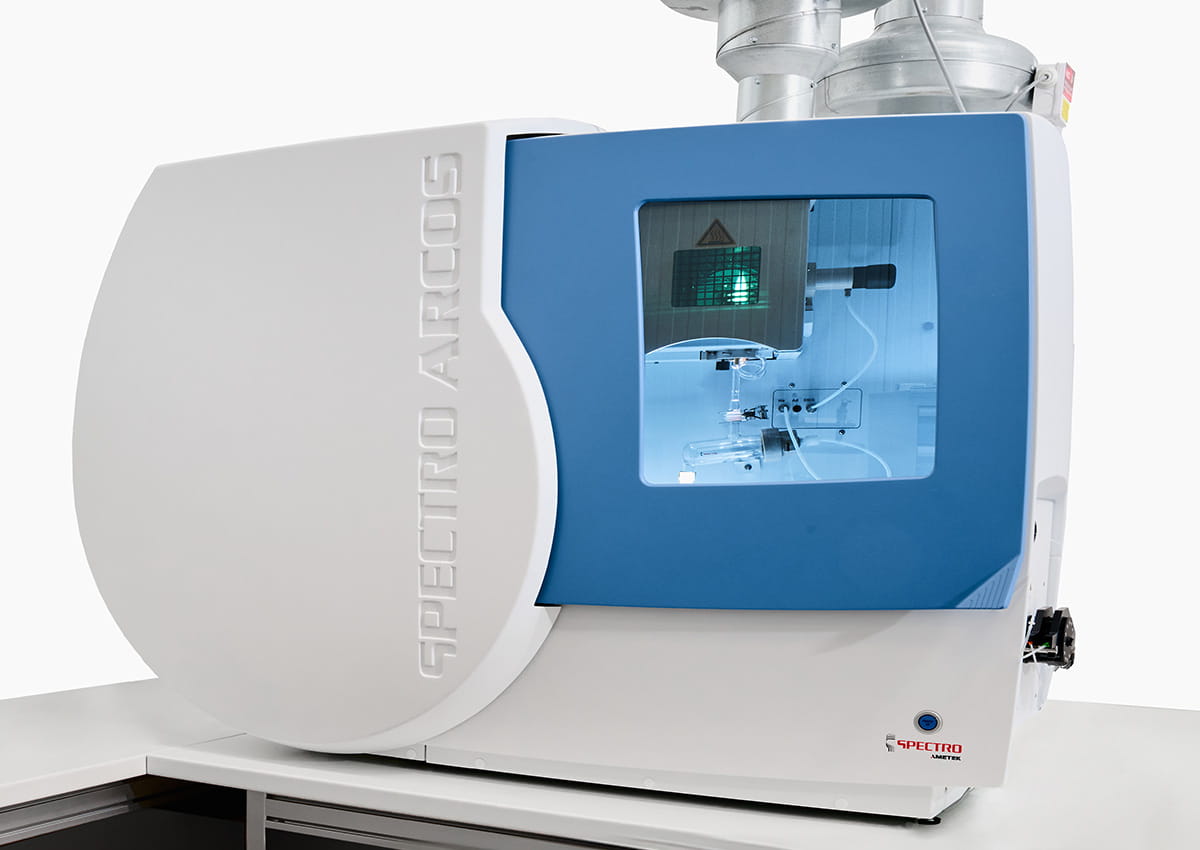
The design of an ICP-OES system
An ICP-OES system consists of several central components that together make possible the analysis process: from plasma generation, through sample feed, to the detection of the radiation emitted. The main components and their functions are described in the following:
Plasma torch
The plasma torch keeps the plasma stable. It also contains the injector through which the atomised sample is introduced into the plasma from the sample feed system.
High frequency generator
The generator provides the energy for the plasma. It operates in a frequency range of 27 or 40 MHz.
Sample introduction system
A peristaltic pump transports the liquid sample to the atomiser. Here, the liquid is converted into an aerosol with the aid of a gas flow. A downstream spray chamber filters out larger droplets before the aerosol reaches the plasma torch via the injector.
Transfer optics
These components guide the radiation from the plasma to the optics that undertake the spectral separation. The task of these components is therefore limited to transmission, not wavelength splitting.
Spectrometer (monochromator/polychromator)
This is where the light is separated into its individual wavelengths. This separation can be undertaken either sequentially (monochromator) or simultaneously (polychromator). A high spectral resolution is crucial for precisely analysing closely spaced lines.
Detector
CID or CCD sensors detect the intensity of the separated radiation. The sensors exposed to the radiation generate an electrical signal that is further processed to analyse quantitatively the element concentration.
Background: ICP-OES as part of atomic emission spectrometry
ICP-OES belongs to the family of atomic emission spectrometry (AES) methods. These techniques are based on the excitation of atoms by the application of energy and emission of electromagnetic radiation in specific wavelengths during this excitation. Each wavelength is characteristic for a specific element and permits its qualitative and quantitative analysis.
Within atomic emission spectrometry, ICP-OES is characterised by the use of an inductively coupled plasma as an energy source. Compared to other AES methods such as flame emission spectrometry (FES), ICP-OES offers significantly higher sensitivity and flexibility, as it is able to analyse numerous elements simultaneously. Due to these characteristics, ICP-OES has established itself as one of the most frequently used methods in modern analytics and is used in numerous industries and fields of research.
What distinguishes ICP-OES from other AES methods?
Compared to flame atomic absorption spectrometry (F-AAS), ICP-OES offers clear advantages, primarily due to the high temperature of the plasma. While the flame in F-AAS reaches a maximum temperature of around 2,800 kelvin, the plasma for ICP-OES is at temperatures of up to 10,000 kelvin. These high temperatures considerably improve the degree of atomisation of the sample, as a larger proportion of the elements is completely atomised.
In addition, ICP-OES permits the ionisation of the elements such that ionic lines can be analysed alongside atomic lines. This aspect is a key advantage, because ionic lines are significantly less sensitive to excitation interference at high temperatures and therefore deliver more precise results. The longer dwell time of the atoms in the plasma as well as the improved temperature homogeneity also ensure the greater precision and reproducibility of the analyses. Modern ICP-OES systems enable up to 70 elements to be analysed simultaneously making them significantly more efficient than F-AAS, which usually only analyses one element at a time. This multi-element capability makes ICP-OES an indispensable tool in elemental analysis.
Applications
Optical emission spectroscopy with inductively coupled plasma (ICP-OES) is suitable for numerous applications, in particular where precise and simultaneous determination of trace elements and key components in samples is required.
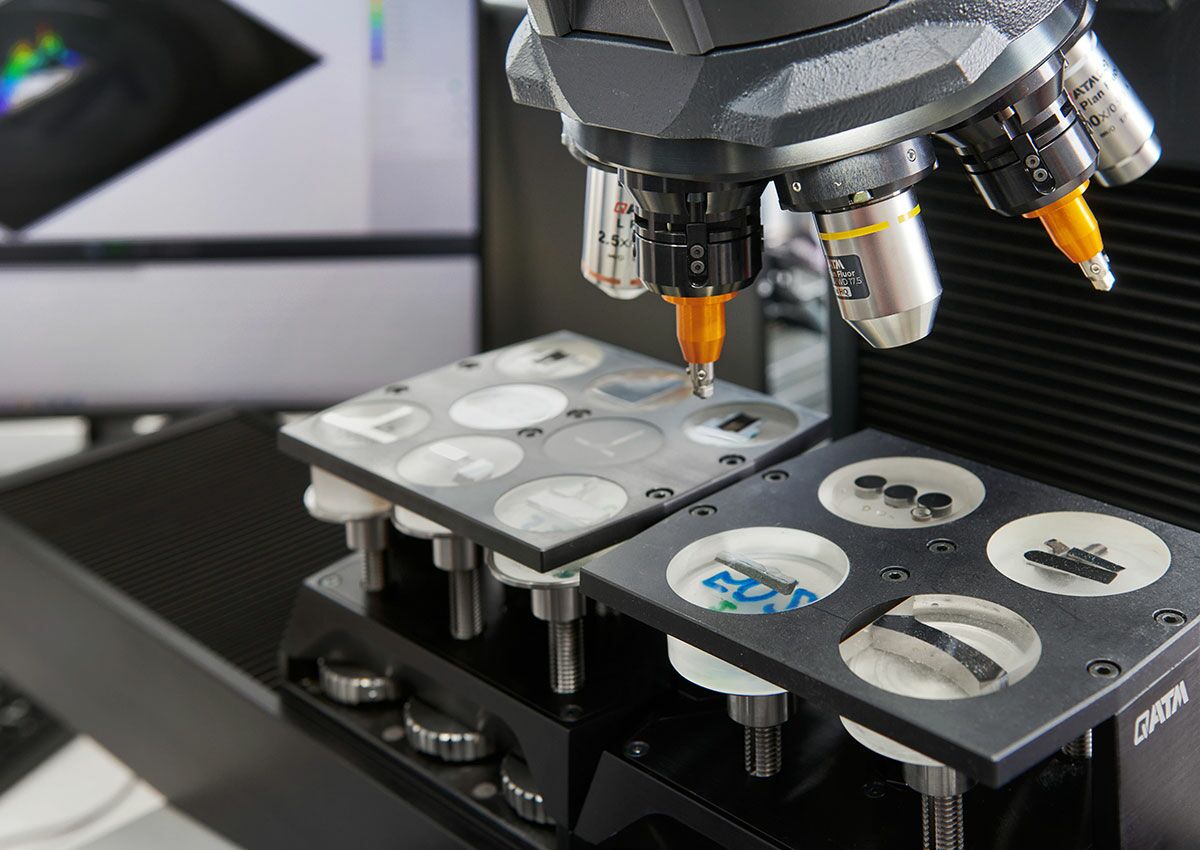
Material sciences
Analysis of metals, alloys and semiconductor materials

Fuel industry
Checking crude oil, coal and bio-fuels for trace metals

Chemical and petrochemical industry
Determination of element content in chemicals and fuels

Pharmaceutical industry
Checking purity of raw materials, process materials and end-products as well as verification of contamination

Food and beverage industry
Checking trace elements, nutrients and contaminants in food and beverages

Environmental analytics
Determination of heavy metals and other elements in water, soil, waste water and sewage sludge
ICP-OES in summary
Optical emission spectroscopy with inductively coupled plasma (ICP-OES) is an analytical method for the determination of element concentrations in samples and uses a high-energy plasma to ionise atoms and emit light. By analysing the specific emission lines in the radiation emitted, numerous elements can be quantified simultaneously, making it a valuable technique in materials science, the pharmaceutical industry and environmental analytics.