
Component Cleanliness Code (CCC)
The smallest of particles can cause considerable disruption in industry and impair the functionality of components. To prevent these problems occurring and to be able to evaluate precisely the cleanliness of components, the component cleanliness code (CCC) was introduced by expert groups in the context of the standards VDA 19.1 and ISO 16232.
Table of contents

Contact us –
expert support is just a conversation away.
Using state-of-the-art analytical methods, we assist you with quality issues, damage claims, and development challenges – providing precise, well-founded, and solution-oriented support.

What is the component cleanliness code (CCC)?
The component cleanliness code (CCC) is a standardised code that describes the maximum permissible particle load on technical components. The CC code is a standardised form for depicting requirements or evaluating the permissible particle load, as well as depicting the actual particle load. The CCC makes it possible to communicate technical cleanliness verification requirements clearly and comprehensibly – from the developer, through production, to quality inspection.
The component cleanliness code (CCC)
at Quality Analysis
- Cleanliness testing according to VDA 19.1 and ISO 16232
- Structured presentation of results in the Component Cleanliness Code
- Clear evaluation according to particle size classes
- Rapid detection of exceedances of limit values and deviations
- Correlative particle analysis using Light microscopy, SEM-EDX and RAMAN spectroscopy
- Consulting on process optimization with regard to technical cleanliness
- Cross-industry expertise – from automotive to medical technology
Layout of the component cleanliness code (CCC)
The component cleanliness code (CCC) indicates, in a combination of letters and numbers – depicted in coded form – how many particles in certain size classes were or are permitted to be found on a defined surface, in a defined volume or on a component. This information permits a clear and comparable evaluation for technical cleanliness verification and assists with the detection of potential risks due to contamination
CCC as the basis for cleanliness specifications
In addition to simply depicting measurement results, the CCC can also be used to specify binding limits. In this way, permissible particle loads in specific size classes can be specified clearly – for example in technical drawings, inspection plans or quality assurance agreements. The CCC acts as a standards-based communication criterion for the requirements on technical cleanliness verification – from development, through production, to the end result.
How is the CCC structured?
The component cleanliness code (CCC) is made up of several elements that permit a comprehensive assessment of the cleanliness of a component. It can look like this: A(B10/C8/D6/E5/F4/G3/H2/I1/J0/K00/L00/M00/N00).
This code takes into account the basis for the evaluation, the size of the particles detected according to size classes, as well as the number of particles in coded form (concentration classes). The individual components of the CCC are explained in more detail below.
Basis for the evaluation (A/V/N)
The CCC starts with a letter – for example "A", "V" or "N" – which indicates the basis on which the evaluation was undertaken. The specific reference sizes are not clearly standardised, but must be stipulated specifically for each application. The abbreviations stand for:
A = Area (e.g. 1000 cm²)
V = Volume (e.g. 100 cm³)
N = Individual part (or number of components)
Particle size classes at a glance (B-N)
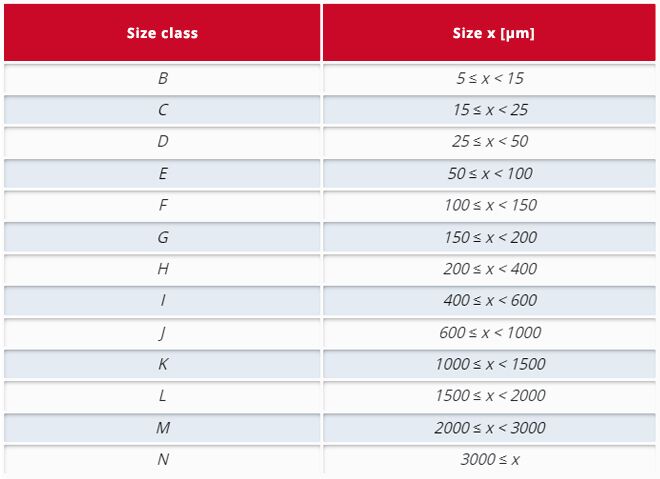
This letter is followed by codes for different particle size classes – from 5 µm to over 3000 µm. The letters B to N are often used for this purpose, although they do not represent normative standards. Particles from 5 µm to less than 15 µm, for example, correspond to size class B, particles larger than 3000 µm to size class N.
Concentration classes (00-20)
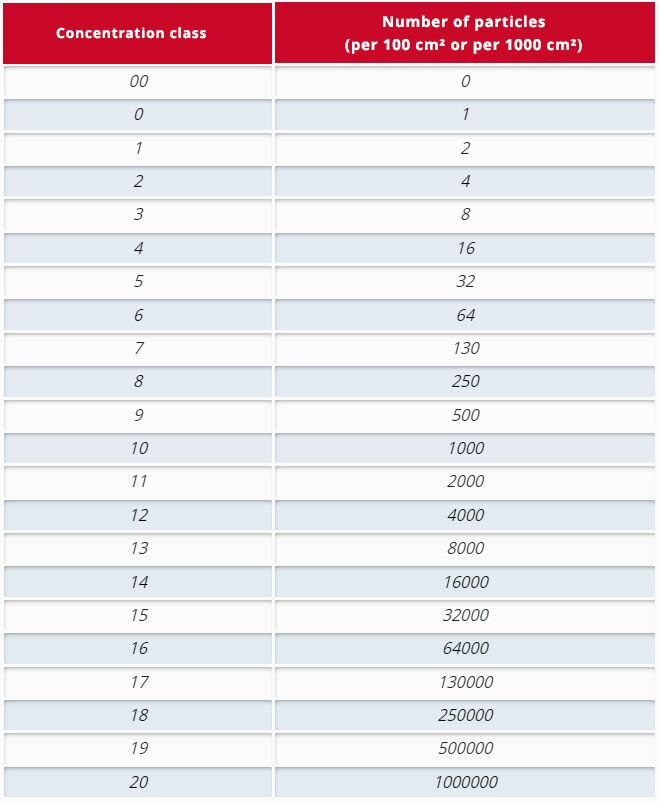
Each of these letters is followed by a coded value (e.g. B10), which indicates a specific range for the particle count, but not an absolute number. The following table can be used to break down the coding and read the permitted or detected number of particles. The complete assignment for all concentration classes is specified in the standard VDA 19.1:2015.

Decoding the numbers in the CCC – an example
A simplified component cleanliness code (CCC) from practice could look like this:
A(B10/C8/D6/E5/F4/G3/H2/I1/J0/K00/L00/M00/N00)
- The first letter (A) indicates that the analysis refers to a defined area (e.g. 1000 cm²)
- The letters inside the brackets stand for different particle size classes, for example B for particles from 5–15 µm, C for particles from 15–25 µm and D for 25–50 µm
- The numbers after the letters, such as B10, C8 or D6, are coded values that indicate certain particle count ranges (concentration classes). The list shows the permissible or actual particle counts for the first four size classes
The component cleanliness code (CCC) in the context of standards
The component cleanliness code (CCC) is closely based on the established standards VDA 19.1 and ISO 16232, which are regarded as the authoritative standards for technical cleanliness verification on components – particularly in the automotive industry.
Although the CCC does not form a direct part of these standards, it uses their classification and serves as a compact specification or evaluation of whether a component meets the cleanliness requirements specified. In industry, the CCC has established itself as an efficient means of communication between customers, suppliers and inspection service providers.
The component cleanliness code in summary
The component cleanliness code (CCC) is a standard used to specify the cleanliness requirements for parts and components. The main focus here is on technical cleanliness verification, i.e. the quantity and size of particles that could impair function. The CCC expresses the maximum permissible or actual particle load.