
Wall thickness measurement
Wall thickness measurement (or wall thickness analysis) is a crucial method in industrial quality assurance. It is used to determine precisely the thickness of materials, components or pipes and thus detect deviations within the specified tolerances at an early stage.
Table of contents
- Why is wall thickness measurement important?
- Wall thickness measurement at Quality Analysis
- Methods for wall thickness measurement
- Wall thickness measurement with industrial CT explained straightforwardly
- What is the difference between wall thickness measurement and layer thickness measurement?
- Applications for wall thickness measurement
- Wall thickness measurement in summary

Contact us –
expert support is just a conversation away.
Using state-of-the-art analytical methods, we assist you with quality issues, damage claims, and development challenges – providing precise, well-founded, and solution-oriented support.

Why is wall thickness measurement important?
Wall thickness measurement is an analytical method for non-destructive inspection used to determine the wall thickness of a component without damaging it. It is of great importance for quality assurance as well as the structural integrity and the reliability of components and systems.
Regular wall thickness measurements allow potential weaknesses, wear or corrosion processes to be detected and rectified at an early stage before they lead to critical problems.
Wall thickness measurement
at Quality Analysis
At Quality Analysis we support you in quality monitoring with non-destructive inspection methods and modern analytical methods such as 3D-computed tomography, 2D X-ray inspection and optical metrology. For this purpose we rely on the most advanced technologies for wall thickness measurement down to the nanometre range. Along with the classic measurement of wall thickness, our precise analyses also permit the detection of volume deficits such as shrinkage cavities, pores and inclusions.
- Fast, reliable measurement results
- Clear 3D depiction
- Nano, micro and macro-CT – matched to the component size
- Ability to detect detail down to 0.2 µm with the latest nano-CT systems
- Wall thickness analysis with colour-coded depiction of deviations
- Mobile deployment of our 3D scanners
Methods for wall thickness measurement
The choice of a suitable method for wall thickness measurement depends on various factors, including material type, component geometry, accessibility and the required measuring accuracy. The most important methods are:
Ultrasonic wall thickness measurement
Wall thickness measurement is one of the most common applications for ultrasonic inspection in non-destructive testing. It is used in particular for thick-walled materials such as pipelines, pressure vessels, tank walls or ship hulls. An ultrasonic device measures the time it takes for a sound pulse to propagate through the material and return after reflection at the rear wall. The thickness of the wall is calculated from this propagation time.
3D scanning
Modern 3D scanning – especially optical methods with incident light scanners – precisely acquires the external geometry of objects and is particularly helpful for components with complex shapes where conventional measurement methods reach their limits. Non-destructive methods such as industrial computed tomography (CT) are also used to analyse wall thicknesses and make internal structures visible in 3D.
Computed tomography
Industrial 3D computed tomography is the leading method for non-destructive wall thickness measurement and analysis of complex geometries, including internal geometries. With the aid of CT technology, the wall thickness can be acquired directly on the actual component – irrespective of its shape or material density. The measured data obtained can be compared with existing CAD data and, for example, nominal-actual comparisons undertaken. This information creates the basis for specific process optimisation and ensures compliance with the strictest quality standards.
Wall thickness measurement with industrial CT explained straightforwardly
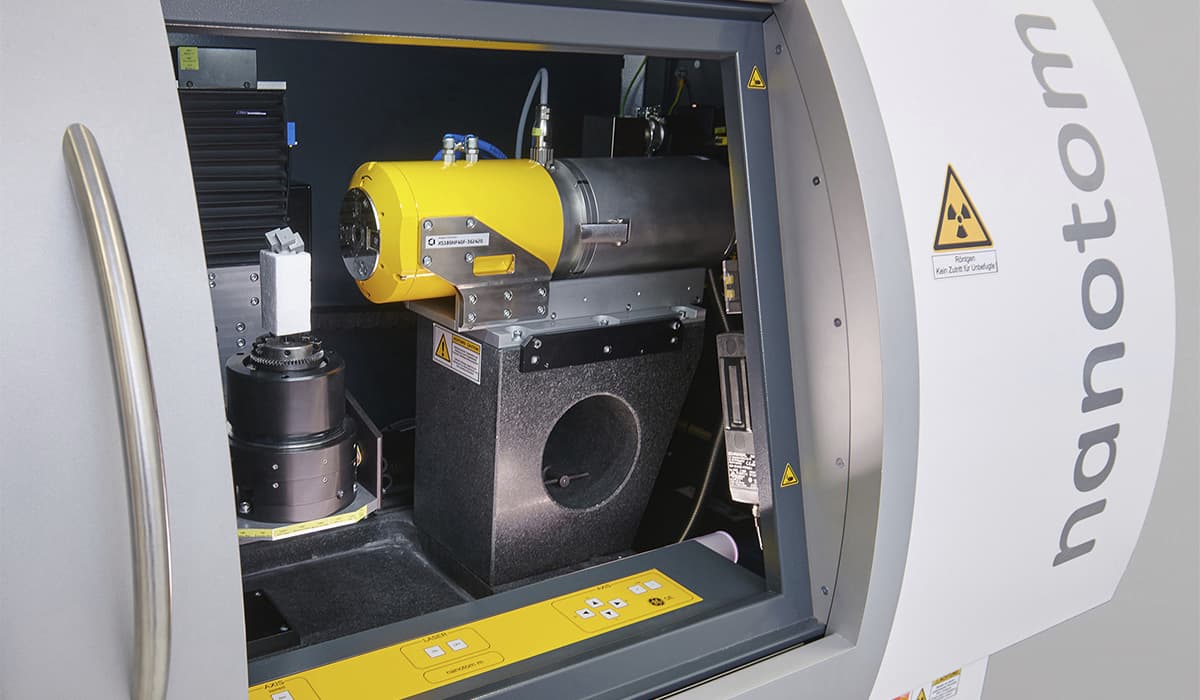
3D image using X-rays
Wall thickness measurement with industrial computed tomography (CT) uses X-rays to create a 3D image of a component. Radiation is applied to the component as it rotates and a detector acquires the beams that have passed through the component. These data are reconstructed into a three-dimensional volume image that depicts the wall thicknesses.
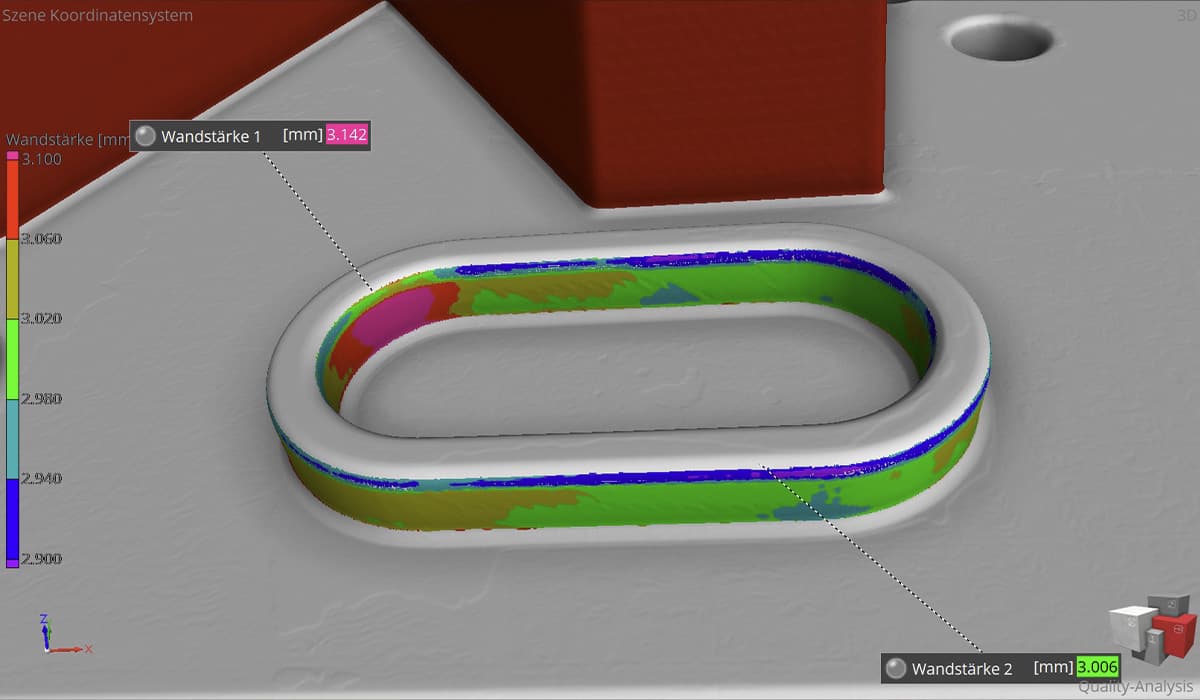
Colour-coded depiction
In a colour-coded depiction, areas within the specifications are shown in green, slight deviations in yellow and critical deviations in red. This colour-coded depiction makes it possible to identify quickly problematic areas and analyse them further without damaging the component.
What is the difference between wall thickness measurement and layer thickness measurement?
While wall thickness measurement focuses on determining the wall thickness of a material, layer thickness measurement analyses the thickness of coatings applied such as paint. Both methods are crucial for quality assurance, but they deal with different aspects of material thickness and require different inspection methods. Wall thickness measurement is undertaken exclusively using non-destructive inspection methods, while destructive material inspection such as scanning electron microscopy (SEM) is also used for layer thickness measurement.
Applications for wall thickness measurement
Wall thickness measurement is used in various sectors and applications where the control of material thickness and integrity is of crucial importance. Here are some of the important applications:

Automotive industry
Wall thickness measurement plays a central role in the automotive industry, as it contributes to the quality assurance and durability of all components. It is used to ensure that shafts, gearwheels, turbochargers and other critical components meet the required specifications, and therefore contribute to the stability and efficiency of modern vehicles.
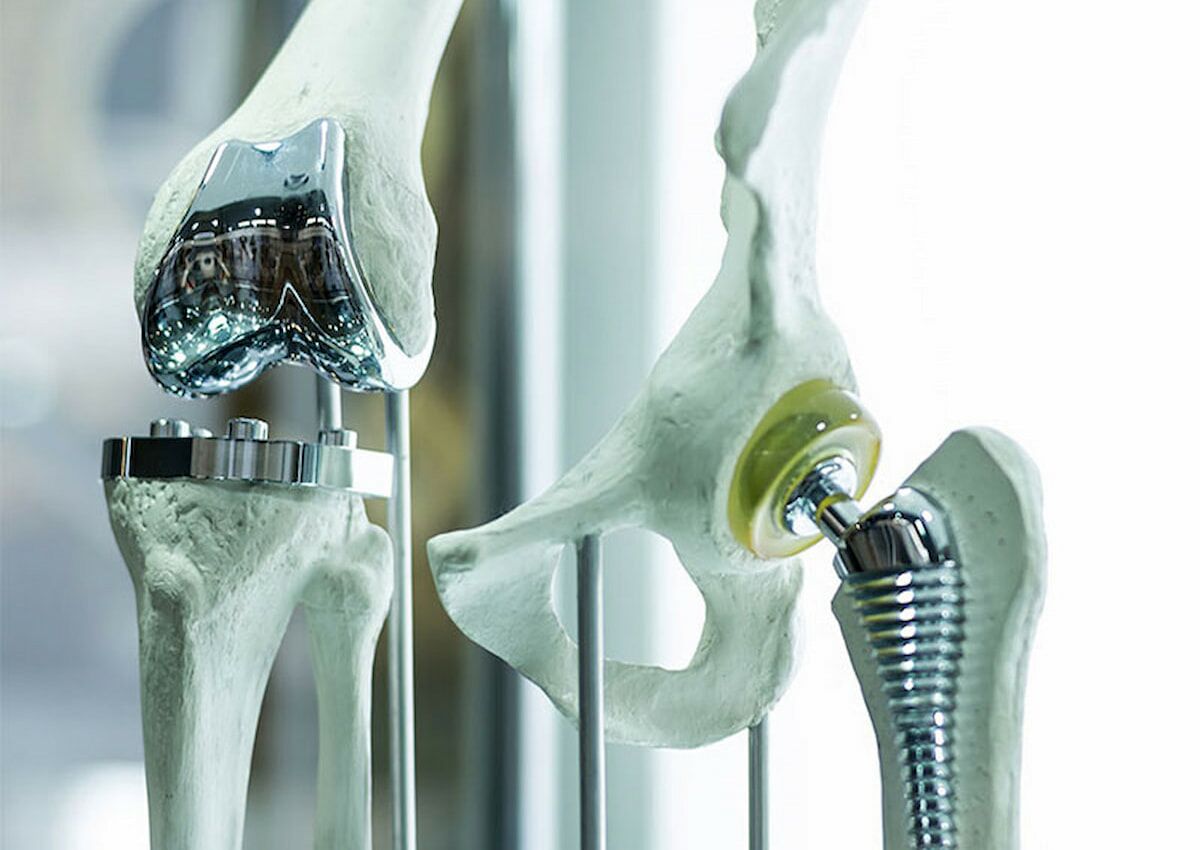
Medical technology
In medical technology, wall thickness measurement is used to check medical devices such as heart valves, implants and other medical components. Here too, the goal is to ensure the highest quality and reliability. Colour-coded wall thickness analysis can be used to depict deviations and thus aid the rapid identification of critical areas.

Aerospace
In the aerospace industry, wall thickness measurement is used to check the wall thickness of complex component geometries such as fuselage structures and wings. This aspect is important for the safety and efficiency of aircraft.

Plastics industry
Polymer materials and products must withstand the planned exposure. Therefore geometry comparisons such as nominal-actual comparisons or wall thickness measurements with colour-coded 3D depiction are undertaken in the plastics industry. In this way, deviations can be detected and analysed.
Wall thickness measurement in summary
Wall thickness measurement, also called wall thickness analysis, is a non-destructive inspection method for the determination of the thickness of component walls. It is used for quality assurance and ensures that components comply with the required tolerances. Typical methods include optical metrology (3D scanning) and, in particular, industrial computed tomography.